Important Notice. This document is a confidential summary for authorized review by accredited investors only as defined under SEC Regulation D Rule 506(c). It does not constitute an offer to sell or solicitation of an offer to buy securities. Any offering will be made exclusively through a formal Private Placement Memorandum reviewed by securities counsel. All projections are forward-looking and based on modeled assumptions. They are not guarantees of future performance. All investments carry risk including potential loss of principal. Consult your legal, financial, and tax advisors before making any investment decision.
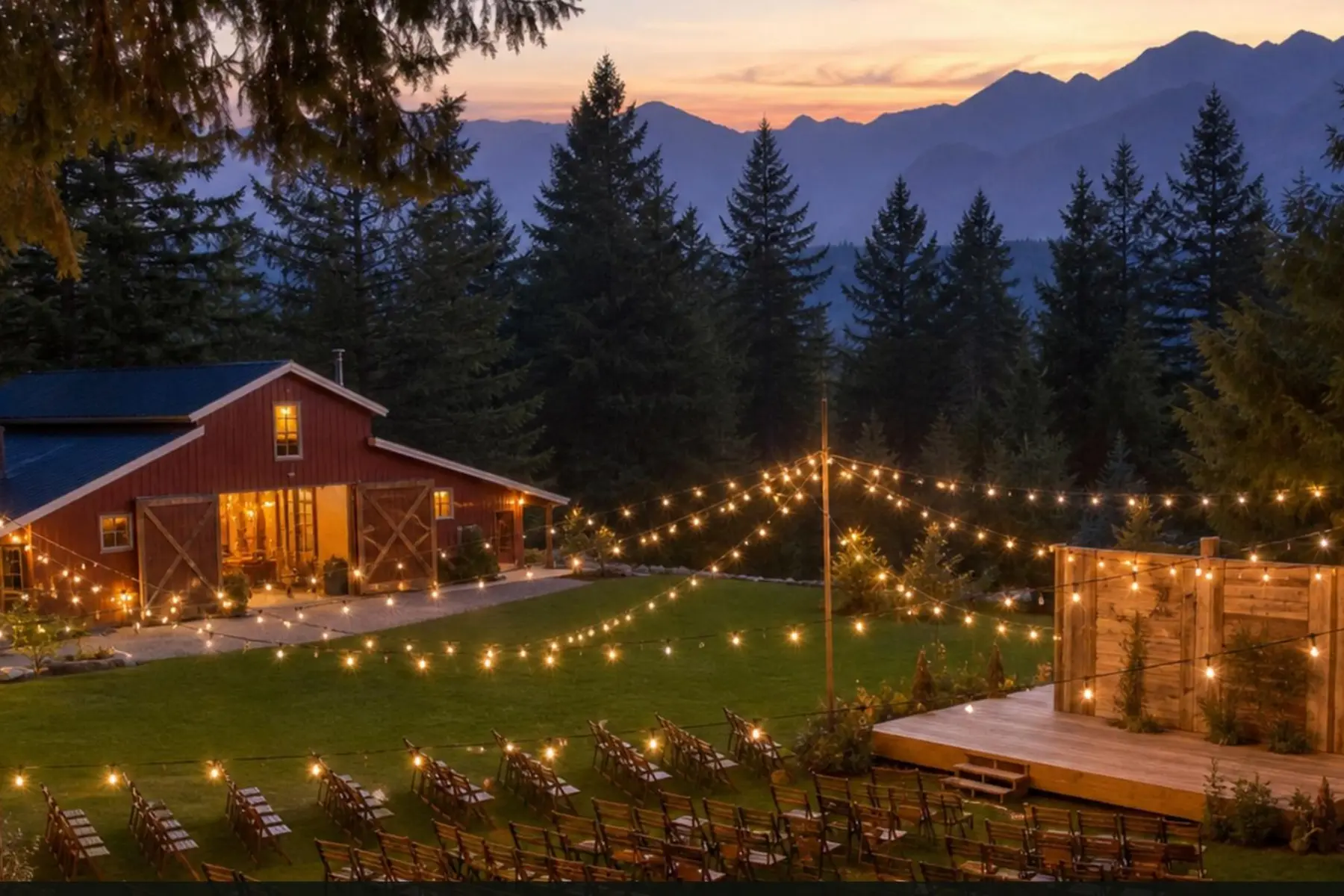
Camden Ranch Estate is a fully operational 220-acre private estate in Elk, Washington generating active revenue from weddings, a U-cut Christmas tree farm, and a newly launched corporate retreat program. The asset is real. The revenue is real. The constraint is debt.
The Series CR-1 raise resolves two things simultaneously. First, debt retirement eliminates $60,000–$90,000 in annual debt service the moment escrow closes — freeing that cash flow for distribution immediately, before a single additional booking is added. Second, at maximum raise, the tiny home construction unlocks overnight lodging revenue: the highest-margin, highest-growth opportunity on the property.
This is not a startup investment. The land is paid for. The venue is operational. The revenue is active. The capital makes a working asset dramatically more productive.
| Attribute | Detail |
|---|---|
| Location | Elk, Washington 99009 — 40 miles north of Spokane International Airport |
| Acreage | 220 acres of old-growth Pacific Northwest forest, meadow, and established grounds |
| Primary Venue | Historic barn venue, 200-guest capacity, professional-grade finish |
| Bridal Suite | Luxury salon-grade getting-ready suite |
| Ceremony Spaces | Custom pergola, gazebo, outdoor hardscape — multiple distinct settings |
| Kitchen | Fully equipped commercial catering kitchen |
| Christmas Tree Farm | U-cut operation, 20+ years established, November–December revenue |
| Revenue Model | Pure venue-only rental. Couples pay all vendors directly. Zero vendor overhead, zero vendor liability. This produces industry-leading operating margins: expenses are setup/cleanup labor, insurance, utilities, maintenance, and on-site staff only. |
| Revenue Status | Active — $420,000+ annual revenue from weddings and Christmas operations |
The mini-max structure means the minimum raise funds the immediate priority — debt retirement and retreat infrastructure. The maximum raise completes the full destination build.
| Use | Amount | Min Raise Funded | Max Raise Funded |
|---|---|---|---|
| Debt Retirement | $700,000–$900,000 | ✓ First priority | ✓ |
| Site Infrastructure | $100,000–$150,000 | ✓ | ✓ Expanded |
| Ground Initiative Course (ELD) | $35,000–$45,000 | ✓ Phase 1 | ✓ Full |
| Fireside Leadership Center | $40,000–$60,000 | ✓ | ✓ |
| Operating Reserve (12 months) | $100,000 | ✓ | ✓ |
| Offering Costs / Legal / Compliance | $50,000–$75,000 | ✓ | ✓ |
| Tiny Home Construction (8–12 units) | $800,000–$1,000,000 | — (requires max raise) | ✓ Full build |
| Total | $1,200,000–$5,000,000 | $1,200,000 minimum | $5,000,000 maximum |
Debt retirement executes on Day 1 of draw. The moment it closes, $60,000–$90,000 in annual cash flow that was consumed by debt service is immediately redirected to distributions and operations. No construction required. No permits required. No additional bookings required.
This is the most important immediate value unlock. It is certain, it is immediate, and it requires nothing beyond the close of escrow.
| State | Annual Revenue | Operating Expenses | Debt Service | Net Operating Income |
|---|---|---|---|---|
| Before Raise (Today) | $420,000 | $185,000 | $80,000 | $155,000 |
| Post-Raise — Debt Cleared, Pricing Corrected, No Lodging Yet | $588,000 | $220,000 | $0 | $368,000 |
| Year 2 — Full Three-Stream Operation | $1,837,000 | $480,000 | $0 | $1,357,000 |
The step from $155,000 NOI to $368,000 NOI requires no new bookings. It requires only: (1) debt retirement, which happens at close, and (2) correcting event pricing to fair market. Both are management decisions, not capital expenditures.
Each stream is modeled across three scenarios. Bear reflects conservative execution. Base reflects the projections used in overall financial modeling. Bull reflects strong execution and market conditions consistent with comparable PNW properties.
| Scenario | Events/Year | Average Rate | Annual Revenue | Operating Margin |
|---|---|---|---|---|
| Bear | ||||
| Current pricing maintained | 40 | $10,500 | $420,000 | 48–55% |
| Base | ||||
| Fair market correction + modest volume growth | 45 | $14,000 | $630,000 | 62–68% |
| Bull | ||||
| Premium pricing + full-estate buyouts | 42 standard + 8 buyouts | $16,000 / $45,000 | $1,032,000 | 68–72% |
Camden Ranch currently prices at approximately $10,500 per event — below fair market by $3,500–$5,500 per event. Comparable private estate venues in the Pacific Northwest command $14,000–$20,000 per event (Kaiplan, March 2026). On 40 events, this gap represents $140,000–$220,000 in annual revenue left uncaptured. Moving to fair market is a management decision, not a capital expenditure.
Source: Kaiplan.app Washington Wedding Cost Guide, March 2026. Eastern Washington premium private estate venues $10,000–$15,000 flat rental; national average venue cost $12,200–$12,900 (The Knot Real Weddings Study 2026). US wedding services market $66.2B (2025), 6.8% CAGR to $95.35B by 2030 (Grand View Research).
8–12 luxury tiny homes (600–900 sq ft) positioned in old-growth forest at scenic intervals across the 220-acre property. Real beds, wood stoves, private decks, curated interiors. Not camping. Fully appointed private forest accommodations. Available only at maximum raise.
| Scenario | Units | Avg Rate/Night | Occupancy | Annual Gross | Annual NOI |
|---|---|---|---|---|---|
| Bear | |||||
| Conservative launch, shoulder season ramp | 8 | $250 | 40% | $292,000 | $212,000 |
| Base | |||||
| Stabilized operation, retreat integration | 10 | $325 | 60% | $711,750 | $611,750 |
| Bull | |||||
| Full build, premium positioning, high season | 12 | $375 | 70% | $1,149,750 | $1,029,750 |
Well below bear case projection of 40%. Industry-wide break-even for glamping operations runs 25–40% (Cairn Consulting 2025). Retreat clients fill units automatically — Summit and Executive Offsite packages include overnight stays, creating baseline occupancy from the corporate retreat program alone.
Source: Cairn Consulting Group, US Glamping Industry Report 2025 — ADR $251/night (up 21% from 2023), occupancy 50–65% blended, peak season 70–90%, NOI margins 40–60%. Glamping market $3.5B (2023), projected to double by 2031 (Rentals United, Feb 2026).
Three structured packages targeting the rapidly expanding corporate retreat market. September, October, and May — the three most popular retreat months nationally — align directly with Camden Ranch's shoulder season calendar, creating a natural revenue diversification opportunity with minimal operational overlap with peak wedding season.
| Package | Price Range | Target Clients |
|---|---|---|
| The Catalyst (half-day) | $4,500–$7,000 | Local/regional teams, department offsites |
| The Summit (2 days/1 night) | $18,000–$28,000 | Leadership teams, 15–30 people |
| The Executive Offsite (3 days/2 nights) | $30,000–$50,000 | C-suite, board retreats, Fortune 500 leadership |
6 bookings avg $12K. Primarily Catalyst and Summit packages. Local/regional clients only.
Year 2: $180K
12 bookings avg $18K. Mix of Summit and Executive Offsite. Regional + national clients.
Year 2: $450K
20 bookings avg $28K. Consistent Executive Offsite bookings with Fortune 1000 teams.
Year 2: $900K+
Source: Allied Market Research, "Corporate Retreats Market," October 2025 — $31.8B (2024), projected $73.7B by 2034, 9.1% CAGR. RetreatsAndVenues.com 2025 — avg spend $3,692/employee (21–50 person companies), avg retreat 3.78 days, 70%+ of mid-large companies host annual retreats. Most popular months: September 21.7%, October 20.2%, May 18.4%.
This section will be immediately recognized by any experienced operator reviewing this asset: there is a systematic revenue multiplier available through vendor activation that requires zero capital expenditure and has not yet been implemented. It is a management decision.
Every wedding vendor who experiences Camden Ranch — personally, professionally, in the space — becomes a permanent referral source. The bridal suite is the most photogenic beauty space in Eastern Washington. The venue is objectively exceptional. The problem is that most vendors in the region have never been inside it. The solution is structured industry programming that brings them in.
| Program | Format | Direct Revenue/Year | Referral Value |
|---|---|---|---|
| Hair/Makeup Artist Showcases (quarterly) | 10–15 artists use bridal suite professionally, $150–$250/artist | $6,000–$15,000 | Each artist tells every bride they book about Camden Ranch |
| Photographer Portfolio Days (4–6/year) | 8–10 photographers shoot on property, $300–$500/photographer | $9,600–$30,000 | Ongoing professional photography + permanent referral source per photographer |
| Bridal Fashion Shows (2–3/year) | 4–6 boutiques showcase collections, $500–$2,000/boutique | $4,000–$36,000 | Every boutique tells every bride where the show was held |
| Beauty Brand Launches (4–6/year) | Product launch events in bridal suite, $3,000–$8,000/event | $12,000–$48,000 | Aspirational brand association, earned media |
| Total Direct Flywheel Revenue | $31,600–$129,000/year | Exponential referral compounding — every participant recruits the next booking |
This program exists nowhere in the Eastern Washington venue market. It requires no capital — only the execution decision. The direct revenue is meaningful. The referral multiplier on primary wedding bookings is the real value: every artist, photographer, and boutique owner becomes a Camden Ranch ambassador to every client they serve. An institutional buyer or operator would activate this immediately upon acquisition. It is observable upside that requires only management.
The following value unlocks require no construction, no permits, and no capital beyond what the raise provides. They are strategic and operational decisions. Institutional investors will recognize these as the gap between what Camden Ranch earns today and what a properly managed estate of this caliber should earn.
| Value Lever | Current State | Corrected State | Annual Revenue Difference |
|---|---|---|---|
| Event pricing | ~$10,500/event avg | $14,000–$16,000/event avg | +$140,000–$220,000 |
| Vendor referral flywheel | Not activated | Fully activated — 4 program types | +$32,000–$129,000 direct |
| Shoulder season (corporate retreats) | Unused Sept/Oct/May | Corporate retreat programming | +$72,000–$560,000 |
| Christmas programming expansion | U-cut farm only | Farm + corporate holiday events | +$30,000–$50,000 incremental |
| Total Intrinsic Upside | +$274,000–$959,000/year |
This is the range of additional annual revenue available from management decisions that cost nothing to implement. The bear end of this range, added to today's $420,000 base, produces $694,000 in annual revenue — before a single tiny home is built.
| Revenue Stream | Bear Year 2 | Base Year 2 | Bull Year 2 |
|---|---|---|---|
| Weddings / Private Events | $420,000 | $660,000 | $1,032,000 |
| Tiny Home Lodging | $292,000 | $657,000 | $1,149,750 |
| Corporate Retreats | $180,000 | $450,000 | $900,000 |
| Christmas / Holiday | $80,000 | $120,000 | $150,000 |
| Vendor Flywheel (direct) | $32,000 | $75,000 | $129,000 |
| Total Revenue | $1,004,000 | $1,962,000 | $3,360,750 |
| Operating Expenses | ($400,000) | ($490,000) | ($650,000) |
| Net Operating Income | $604,000 | $1,472,000 | $2,710,750 |
| Distribution — Min Raise (7% on $1.2M) | ($84,000) | ($84,000) | ($84,000) |
| Distribution — Max Raise (7% on $5.0M) | ($350,000) | ($350,000) | ($350,000) |
| NOI After Max Raise Distribution | $254,000 | $1,122,000 | $2,360,750 |
All three scenarios — including bear — cover the 7% distribution obligation at maximum raise. In the bear case, $254,000 remains after maximum distribution. In the base case, over $1,000,000 remains. The 7% is the floor. The NOI trajectory above it is what a real estate investor will analyze.
The 7% annual distribution obligation is not fixed — it scales with capital raised. The tables below show coverage at both raise levels across all phases. This is the analysis any accredited investor with real estate experience will run immediately.
At minimum raise, Camden Ranch covers the distribution obligation from existing revenue before closing. Current NOI of $155,000 is below the $200,000 used in the worst-case DSCR above — and it already covers $84,000 in distributions. Revenue would need to fall to zero before minimum raise investors go unpaid. At maximum raise, even the bear scenario in Year 2 produces 1.73x coverage — meaning revenue would need to fall 42% from bear projections to threaten distributions.
Every accredited investor should ask this question. Here is the complete answer.
| Asset Component | Conservative Value | What It Means |
|---|---|---|
| 220 acres of land at ~$19,000/acre (Pend Oreille/Spokane County market rate) | $4,180,000 | Land alone covers the minimum $1.2M raise more than 3× before a single building is counted |
| Operating estate improvements (venue, infrastructure, systems) | $800,000–$1,200,000 | Purpose-built event infrastructure with replacement cost well above book value |
| Current appraised value (land + improvements) | $3,300,000 | Formal appraised value of the estate as it exists today — before any construction |
| Post-build estimated value (8–12 tiny homes added) | $6,900,000+ | Each unit adds $80,000–$120,000 in assessed value; 12 units = up to $1,440,000 additional |
| Income-Based Valuation — Year 2 Base NOI at 8% Cap Rate | $16,962,500 | What the income stream implies at institutional cap rates (CBRE H1 2025: luxury hospitality 8.1%) |
| Capital Raise Stage | Capital Raised | Asset Value (Appraised) | Asset Per $1 Invested |
|---|---|---|---|
| At minimum close ($1.2M) | $1,200,000 | $3,300,000 | $2.75 in appraised value per $1 invested |
| At maximum close ($5M) | $5,000,000 | $3,300,000 | $0.66 at close, improving as development adds value |
| Post-build Year 2 (max raise) | $5,000,000 | $6,900,000+ estimated | $1.38 and rising — no additional capital at risk |
The following uses institutional cap rate benchmarks to illustrate implied property values at various NOI levels. This is not a guaranteed return — it is the arithmetic that any real estate investor will perform. The numbers are presented without editorial comment.
| NOI Level | At 9% Cap Rate | At 8% Cap Rate | At 7.5% Cap Rate |
|---|---|---|---|
| Current NOI ($155,000) | $1,722,000 | $1,937,500 | $2,066,667 |
| Post-pricing correction ($368,000) | $4,088,889 | $4,600,000 | $4,906,667 |
| Year 1 Base NOI ($738,000) | $8,200,000 | $9,225,000 | $9,840,000 |
| Year 2 Base NOI ($1,357,000) | $15,077,778 | $16,962,500 | $18,093,333 |
| Year 2 Bull NOI ($2,710,750) | $30,119,444 | $33,884,375 | $36,143,333 |
Cap rate benchmarks: CBRE H1 2025 Cap Rate Survey — luxury/upper-upscale hospitality 8.1%. JPMorgan Commercial Lending Q4 2025. Private estate venues with lodging components typically trade at 7–10% cap rates.
The 7% annual distribution target is paid quarterly. The obligation scales with capital raised — not fixed. At minimum raise, the total annual distribution obligation is $84,000. At maximum raise, $350,000. Both are covered by existing revenue before construction begins.
| Investment | Annual Distribution (7%) | Quarterly Payment |
|---|---|---|
| $50,000 | $3,500 | $875 |
| $100,000 | $7,000 | $1,750 |
| $250,000 | $17,500 | $4,375 |
| $500,000 | $35,000 | $8,750 |
| $1,000,000 | $70,000 | $17,500 |
At minimum raise ($1.2M), total annual distributions are $84,000 — from a property currently generating $420,000+ in revenue from a single income stream, before debt is retired, before pricing is corrected, before a single tiny home is built, and before a single corporate retreat is booked. The asset is already producing nearly 5× the minimum raise distribution obligation.
| Term | Detail |
|---|---|
| Offering Type | Mini-Max — Regulation D Rule 506(c) |
| Minimum Raise | $1,200,000 (escrow threshold — if not met, all investor funds returned in full) |
| Maximum Raise | $5,000,000 |
| Minimum Investment | $50,000 |
| Security Type | ERC-20 Security Token — tokenized equity interest in Camden Ranch LLC (Washington) |
| Distribution Target | 7% annually on invested capital, paid quarterly (cash or USDC), investor-priority |
| Creditor Protection | UCC-1 lien filed on property — investors as secured creditors |
| Reporting | Annual audited financials, quarterly distribution reports |
| Token Liquidity | Secondary market (accredited investor transfers), quarterly NAV redemption windows |
| Holding Period | Minimum 3–5 years recommended |
| Investor Eligibility | Accredited investors only — verification required before capital accepted |
Founder of Elite Strategies Group and all subsidiary entities: TerraVault, IDT Academy, IRR-S, IFPB, and Camden Ranch Estate. 10+ years in private investment, capital recovery, and alternative finance. Principal architect of the Elite Strategies ecosystem and the TerraVault tokenized real estate platform.
Co-grantor of the Lake Family Dynasty Trust. Responsible for Camden Ranch operations, compliance, venue marketing, vendor relationship management, and guest experience standards across all programming.
Professional venue operators employed by Camden Ranch LLC. Responsible for day-to-day venue operations, event coordination, and property maintenance. Continuity operators with established vendor and client relationships.
Event and lodging revenue depends on bookings, weather, and discretionary spending. PNW wedding and retreat markets have shown consistent growth but are not immune to economic cycles.
Tiny home construction and lodging permits require Spokane/Pend Oreille County approval. Pre-application process not yet initiated. Permits are expected to be obtainable but are not guaranteed.
Minimum 3–5 year hold period expected. No guaranteed secondary market. Token liquidity is a post-close operational development.
If the $1.2M escrow threshold is not met, all investor funds are returned in full. Investors bear no development or operational risk unless the minimum is achieved.
Asset performance depends significantly on management execution. On-site operators provide operational continuity. The venue-only rental model reduces operational complexity and key-person dependency.
Tiny home revenue (available at maximum raise only) depends on construction timeline and permitting. Debt retirement at minimum raise is certain and immediate. Lodging revenue follows a phased timeline.
| Requirement | Responsible Party | Status |
|---|---|---|
| Formal PPM — drafted and reviewed by securities counsel | Lou Ammatucci, Securities Counsel | Pending |
| Camden Ranch LLC operating agreement — investor class added | Securities Counsel | Pending |
| Accredited investor verification (506(c) requirement) | Compliance / Counsel | Pending |
| Escrow account established | Finance | Pending |
| Form D — SEC filing within 15 days of first capital accepted | Securities Counsel | Pending |
| Washington Blue Sky filing | Securities Counsel | Pending |
| ERC-20 Security Token architecture finalized | Technical / Legal | In Progress |
| Lodging permitting — pre-application submission | Operations / Local Counsel | Not Started |
The following analysis employs three independent methodologies to establish fair value for Camden Ranch Estate. All comparable data is sourced from verified third-party databases (Reelvest, Pend Oreille County public records, Washington State wedding industry surveys). Blended conclusion: $5.5M–$8.5M fair value against $2.0M total invested capital over 4–5 years.
Comparable rural land sales in Elk, Washington (2025–2026):
For 220 acres of improved land with income-producing infrastructure, a range of $14,000–$25,000/acre is supportable from current market data. At midpoint ($19,500/acre): $4.29M land value alone. Total Land Comparable range: $4.74M–$7.0M.
Stabilized NOI at current operations (~$310,000 revenue, 40% margin): ~$124,000. At fair market pricing ($14,000–$16,000/event, 50 events): NOI of $280,000–$340,000. Applied at rural event venue cap rates of 7–9%:
Income Capitalization range: $3.9M–$6.5M. Note: income approach is the most conservative methodology here. Land value alone provides a floor that does not depend on income assumptions.
What would it cost to replicate Camden Ranch from scratch?
| Component | Estimated Cost |
|---|---|
| 220 acres at $19,500/acre | $4,290,000 |
| Barn venue construction (comparable rural event barn) | $850,000–$1,200,000 |
| Bridal suite and salon (no comparable within 40 miles) | $180,000–$280,000 |
| Infrastructure (power, water, septic, road) | $320,000–$480,000 |
| Permitting, entitlement, time-to-market (2–4 years) | Not quantifiable |
| Total Replacement Cost Floor | $6.4M+ before permitting risk |
A buyer seeking to replicate Camden Ranch faces $6.4M+ in hard costs — before permitting risk, time-to-market, and the demand uncertainty of starting from zero bookings. Camden Ranch enters with 38–39 confirmed 2026 bookings and zero marketing spend. That is not replicable at any price.
| Method | Range |
|---|---|
| Land Comparable | $4.74M – $7.0M |
| Income Capitalization | $3.9M – $6.5M |
| Replacement Cost Floor | $6.4M+ |
| Blended Fair Value | $5.5M – $8.5M |
Source: Reelvest land database (Mar 2025–Feb 2026), Pend Oreille County public records, Washington State wedding industry data, CBRE cap rate survey H1 2025. Analysis prepared May 2026.
“The venue doesn’t owe loyalty to any demographic. It owes loyalty to the highest yield use on any given date.”